

Mastering the Art: How to Use Comparative Turkic Linguistics for Deeper Language Understanding
To use comparative Turkic linguistics effectively involves systematically analyzing shared features and differences across various Turkic languages to reconstruct Proto-Turkic forms, identify historical sound changes, and map genetic relationships within the family. This guide provides a structured methodology to help linguists, researchers, and advanced language learners embark on this fascinating journey.
Before beginning, a foundational understanding of basic linguistic concepts such as phonetics, morphology, and syntax is beneficial. Familiarity with at least one Turkic language, while not strictly required, will significantly aid in recognizing patterns and applying the methods discussed.
1. Grasp the Fundamentals of Comparative Linguistics
The journey into comparative Turkic linguistics begins with a solid understanding of the underlying principles that govern all comparative linguistic studies. This field is not merely about finding similarities but about identifying systematic correspondences that point to a shared ancestral language.
Understanding the Comparative Method
The comparative method is a cornerstone of historical linguistics. It involves the systematic comparison of features (phonological, morphological, lexical) across two or more related languages to infer properties of their common ancestor and the changes that led to the attested daughter languages. For Turkic, this means moving beyond superficial resemblances to pinpoint regular sound correspondences and shared grammatical structures that cannot be attributed to borrowing.
Key Concepts: Cognates, Sound Laws, and Reconstruction
Central to this method are cognates, which are words in different languages that derive from a common ancestral word. For example, the word for ‘foot’ or ‘leg’ in many Turkic languages (e.g., Turkish ayak, Azerbaijani ayaq, Kazakh ayaq) are cognates, pointing to a Proto-Turkic form. Sound laws are regular, systematic sound changes that occur over time in a language, often affecting entire classes of words. Identifying these laws is crucial for distinguishing genuine cognates from loanwords or accidental similarities. Finally, reconstruction is the process of inferring the form of a word or grammatical feature in a proto-language based on the evidence from its daughter languages.
The comparative method aims to establish genetic relationships between languages by systematically identifying regular sound correspondences and shared innovations, distinguishing them from similarities due to chance or contact. The reconstruction of proto-forms is a primary objective, allowing linguists to trace the historical trajectory of a language family.
To deepen your theoretical grounding, exploring foundational texts on historical linguistics is highly recommended. Understanding how verbs and other grammatical elements evolve across different Turkic branches can reveal deep insights into the language family’s history.
2. Select Your Turkic Languages for Comparison
Choosing which Turkic languages to compare is a critical initial step that significantly influences the scope and feasibility of your linguistic analysis. A strategic selection ensures a manageable yet representative dataset for your research.
Identifying Language Branches and Relationships
The Turkic language family is vast and diverse, traditionally divided into several main branches, though classifications can vary. Common groupings include Oghuz (e.g., Turkish, Azerbaijani, Turkmen), Kipchak (e.g., Kazakh, Kyrgyz, Tatar), Karluk (e.g., Uzbek, Uyghur), Siberian (e.g., Sakha/Yakut, Tuvan), and Oghur (e.g., Chuvash, historical Khazar). For effective comparative work, it’s often most productive to select languages from different established branches to capture a wider range of linguistic divergence and convergence. For instance, comparing a language from the Oghuz branch with one from the Kipchak branch can highlight distinct evolutionary paths from a common ancestor.
Accessing Reliable Linguistic Resources
The accuracy of your comparative analysis hinges on the quality and reliability of your linguistic data. Seek out academic grammars, dictionaries, and linguistic atlases that provide detailed information on phonology, morphology, syntax, and lexicon for each chosen language. Online linguistic databases and scholarly articles are also invaluable. Prioritize sources written by specialists in Turkic linguistics. While modern dictionaries and learning materials are helpful, historical grammars and etymological dictionaries are often more useful for comparative work as they address older forms and etymologies. Platforms like Glottolog are essential for understanding genealogical classifications and accessing bibliographical information for a wide array of languages.
Glottolog provides a comprehensive catalog of the world’s languages, their genetic affiliations, and bibliographical information for linguistic descriptions, making it an indispensable tool for comparative linguists seeking reliable data sources.
When selecting resources, consider the specific aspects you intend to compare. For example, if you are focusing on vocabulary related to nature, ensure your dictionaries provide comprehensive entries and, ideally, etymological notes. Likewise, for grammatical comparisons, a detailed academic grammar is superior to a simple phrasebook.
3. Begin with Phonological Correspondences
The most systematic and often the first step in comparative linguistics is establishing regular phonological correspondences. These regular sound changes are the bedrock upon which genetic relationships are built and proto-forms are reconstructed.
Establishing Regular Sound Changes
This process involves comparing sets of cognate words across your chosen Turkic languages and noting how specific sounds in one language correspond to sounds in another. For example, if you observe that a ‘d’ sound in one language consistently corresponds to a ‘y’ sound in another, you’ve likely identified a regular sound change. It’s crucial that these correspondences are regular, meaning they apply consistently across many words, not just isolated examples. Irregular correspondences often indicate borrowing or chance similarity rather than genetic inheritance. Documenting these patterns meticulously, perhaps using a table, will help you visualize the transformations.
Identifying Proto-Forms
Once you’ve established several regular sound correspondences, you can begin the exciting work of identifying proto-forms. This involves inferring the sound in the ancestral Proto-Turkic language that gave rise to the corresponding sounds in the daughter languages. For instance, if Turkish ‘a’ corresponds to Azerbaijani ‘a’ and Kazakh ‘a’, it’s highly probable the Proto-Turkic sound was also ‘a’. However, if Turkish ‘g’ corresponds to Chagatai ‘ğ’ (a velar fricative) and Old Turkic ‘g’, then the proto-sound was likely Proto-Turkic ‘*g’. This process requires careful judgment and an understanding of common sound changes (e.g., spirantization, assimilation, vowel harmony shifts). The goal is to reconstruct the simplest possible proto-sound that can explain all the observed daughter-language reflexes.
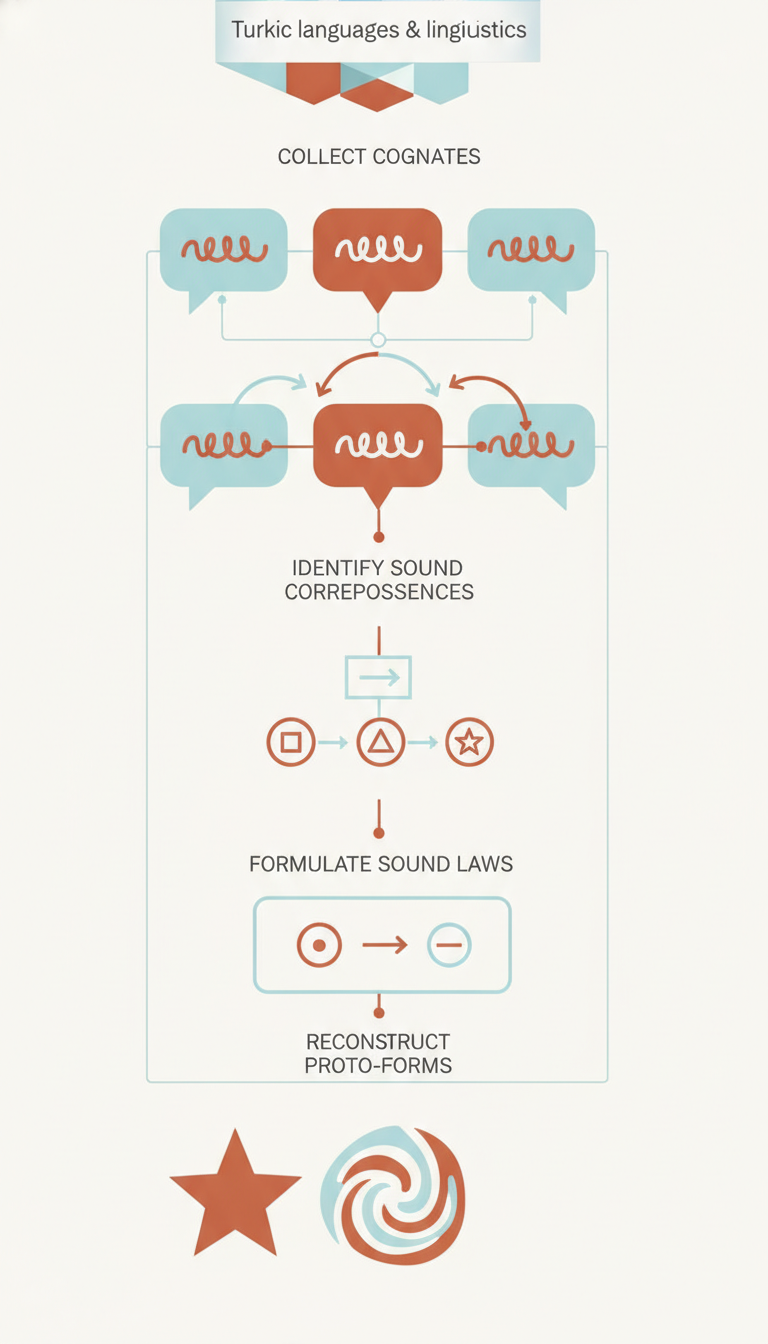
For example, comparing words like: Turkish taş, Azerbaijani daş, Turkmen daş (meaning ‘stone’) might lead to the reconstruction of Proto-Turkic *tāš or *daš, depending on the wider evidence for initial consonants. Similarly, looking at numbers can often yield valuable insights due to their resistance to borrowing and their frequent usage, making them excellent candidates for revealing archaic phonological features.
4. Analyze Morphological and Grammatical Structures
Beyond sounds and words, comparative Turkic linguistics extends to the intricate structures of grammar. The shared architecture of Turkic morphology and syntax provides compelling evidence for their common origin and offers insights into the evolution of grammatical categories.
Comparing Case Systems and Verbal Endings
Turkic languages are renowned for their agglutinative nature, meaning they build words by adding suffixes to a root. A comparative study of case systems (e.g., nominative, accusative, genitive, dative, locative, ablative) and verbal conjugations (tenses, moods, aspects) reveals striking similarities and systematic differences across the family. For instance, the dative case ending is often represented by suffixes like -a/-e or -ġa/-ge across various Turkic languages, while the ablative might involve -dan/-den or -tan/-ten, albeit with phonological variations. Identifying which suffixes are cognate and how their forms have diverged allows for the reconstruction of Proto-Turkic morphological markers. Attention to the conditions under which different allomorphs appear (e.g., due to vowel harmony or consonant assimilation) is crucial.
Examining Word Order and Syntax
While most Turkic languages maintain a Subject-Object-Verb (SOV) word order, subtle variations and structural differences can still be observed and analyzed comparatively. How possessive constructions are formed, the use of postpositions versus prepositions (Turkic languages predominantly use postpositions), and the structure of compound sentences all offer avenues for comparative research. For instance, the use of converbs (or adverbial participles) is a highly characteristic feature of Turkic syntax, and comparing their forms and functions across languages can shed light on their historical development and diversification. Documenting these patterns systematically, perhaps by examining common common phrases and their structural equivalents, can reveal deeper syntactic relationships.
5. Investigate Lexical Cognates and Semantic Shifts
While phonology and grammar provide the backbone, the lexicon offers a rich tapestry of data for comparative Turkic linguistics, allowing for the identification of shared vocabulary and the tracing of semantic evolution.
Identifying Shared Vocabulary
After establishing regular sound correspondences, the next step is to compile lists of potential cognates across your selected languages. This involves comparing core vocabulary items—words for body parts, family relations, basic actions, elements of nature, and common objects—which are typically more resistant to borrowing. For example, words for ‘water’ (e.g., Turkish su, Azerbaijani su, Kazakh su), ‘hand’ (e.g., Turkish el, Azerbaijani əl, Kyrgyz kol – showing different proto-forms or developments), or ‘mother’ (e.g., Turkish ana, Azerbaijani ana, Kazakh ana) are strong candidates for cognacy. It’s essential to filter out loanwords, which are often identifiable by their irregular phonological correspondences. Cross-referencing with etymological dictionaries and historical texts is vital here. A thorough approach might involve using a dedicated search tool to find potential cognates quickly, followed by rigorous verification.
Tracing Semantic Evolution
Even among cognates, the meaning of a word can shift over time and across different languages. Tracing these semantic shifts provides insights into cultural, environmental, and historical divergences. For example, a word that originally meant ‘bird’ might come to mean ‘chicken’ in one language and ‘falcon’ in another. Similarly, a word for a general concept might narrow or broaden its meaning. Documenting these changes helps to understand not only linguistic evolution but also the cultural trajectories of the communities speaking these languages. Understanding how the semantic fields of words related to family, for instance, have evolved can reveal changes in social structures or emphasis.
Lexical comparison, when combined with systematic phonological analysis, provides robust evidence for genetic relationships and allows for the reconstruction of proto-lexica, offering a window into the cultural and material world of ancestral speech communities.
6. Formulate and Test Hypotheses
The final stage in comparative Turkic linguistics involves synthesizing your observations into coherent hypotheses and rigorously testing them against available evidence. This iterative process refines your understanding of Turkic linguistic history.
Developing Reconstruction Hypotheses
Based on the regular sound correspondences, morphological patterns, and lexical cognates you’ve identified, begin to formulate hypotheses about the nature of Proto-Turkic. This includes proposed proto-phonemes, proto-morphemes, and proto-lexical items. For each reconstruction, ensure it accounts for all the observed reflexes in the daughter languages through established sound laws and morphological developments. Proto-forms are conventionally marked with an asterisk (*) to denote their reconstructed, rather than attested, status (e.g., *tag for ‘mountain’). Your hypotheses should strive for parsimony, meaning the simplest explanation that accounts for the most data is generally preferred.
Cross-Referencing with Historical Data
Once you have developed reconstruction hypotheses, it is crucial to cross-reference them with historical linguistic data and archaeological findings where available. Old Turkic inscriptions (like the Orkhon Inscriptions), medieval texts, and early travelogues can provide invaluable insights into earlier stages of Turkic languages, validating or challenging your reconstructions. For example, if your reconstructed Proto-Turkic sound system predicts a certain feature for Old Turkic that is not found in the inscriptions, you may need to revise your hypothesis. This interdisciplinary approach strengthens the validity of your linguistic conclusions and grounds them in broader historical and cultural contexts. Comparing your findings with established scholarship on the various Turkic languages can further refine your understanding.
Common Mistakes to Avoid
Engaging in comparative Turkic linguistics is a complex undertaking, and certain pitfalls can lead to erroneous conclusions. Being aware of these common mistakes can significantly improve the quality and accuracy of your research:
- Ignoring Loanwords: One of the most frequent errors is confusing loanwords (words borrowed from another language) with cognates (words inherited from a common ancestor). Loanwords often do not follow the regular sound changes of the receiving language, leading to irregular correspondences. Always verify the origin of similar-looking words.
- Assuming Superficial Similarities: Not all similarities indicate a genetic relationship. Chance resemblances or linguistic universals can create apparent cognates. A rigorous application of the comparative method, focusing on *regular* sound changes across many examples, is essential to differentiate true cognates.
- Lack of Systematic Methodology: Haphazardly comparing words or grammatical features without a consistent methodology will yield unreliable results. Follow a structured approach, starting with phonology, then morphology, and lexicon, ensuring each step builds upon the last.
- Over-reliance on a Single Source: Relying on just one dictionary or grammar for a language can introduce biases or inaccuracies. Always cross-reference multiple authoritative sources to ensure data validity and comprehensiveness.
- Disregarding Dialectal Variation: Within any Turkic language, there are often significant dialectal differences. Acknowledging and accounting for these variations is crucial, as comparing a dialect of one language to the standard form of another might obscure or distort true historical relationships.
Frequently Asked Questions (FAQ)
- What is the primary goal of comparative Turkic linguistics?
- Its main goal is to reconstruct Proto-Turkic, understand the historical development of individual Turkic languages, and accurately map their genetic relationships within the language family.
- How many Turkic languages should I compare initially?
- For initial studies, comparing 2-3 languages from different major branches (e.g., one Oghuz, one Kipchak, one Karluk) provides a good balance for observing divergence without overwhelming complexity.
- Is it necessary to know all the languages I’m comparing?
- While direct fluency is not strictly necessary, a working knowledge of their phonology, morphology, and basic vocabulary, often acquired through reliable linguistic resources, is essential for accurate comparison.
- What are some reliable online resources for Turkic linguistic data?
- Glottolog is excellent for language classification and bibliographies; specific university linguistics departments often host open-access data, and academic journals publish relevant articles.
- How does comparative linguistics help language learners?
- It helps learners by revealing underlying patterns and shared structures, making it easier to grasp related vocabulary and grammatical rules across different Turkic languages, thereby enhancing cross-linguistic understanding.
Take the Next Step in Your Linguistic Journey
Applying the principles of comparative Turkic linguistics is a deeply rewarding endeavor that significantly enriches your understanding of language history and evolution. By following these systematic steps, you can move from a general interest to conducting rigorous linguistic analysis.
Ready to delve deeper into the fascinating world of Turkic languages? Explore TurkicLex’s comparison tools to see similarities and differences firsthand, or browse our blog for more insights into the Turkic linguistic landscape.