

Unraveling the Turkic Language Family: A Comprehensive Guide
The world’s linguistic map is a mosaic of intricate connections, and among its most fascinating and widespread components is the Turkic Language Family. Spanning continents and millennia, these languages are spoken by hundreds of millions of people, forming a critical cultural and historical bridge across vast swathes of Eurasia. For language learners, academic linguists, researchers, and those with heritage ties to Turkic cultures, understanding this family is key to appreciating a profound legacy.
This guide aims to demystify the Turkic Language Family, exploring its origins, unique linguistic characteristics, geographic spread, and the debates surrounding its classification. Whether you’re a beginner curious about the shared roots of languages like Turkish and Kazakh, or an advanced scholar seeking a concise overview, you’ll find a foundational understanding of one of the world’s most significant language groups.
The Tapestry of Turkic Languages: An Overview
At its core, the Turkic Language Family is a collection of genetically related languages spoken across a massive geographic expanse. From the Balkans to Siberia, and from the Middle East to China, the influence and presence of Turkic languages are undeniable. This family is characterized by a set of shared linguistic features, which suggest a common ancestor: Proto-Turkic. While individual Turkic languages have evolved distinctly over centuries, a remarkable degree of mutual intelligibility often exists, particularly between closely related branches.
The term "Turkic" itself refers to this language family, not solely to the modern Turkish language of Turkey, which is just one, albeit prominent, member. The sheer diversity within the Turkic Language Family is astounding, encompassing everything from major national languages with tens of millions of speakers to smaller, often endangered, regional tongues. Understanding this overarching structure is the first step in appreciating the intricate web of Turkic linguistic heritage.
Geographic Footprint: From Asia to Europe
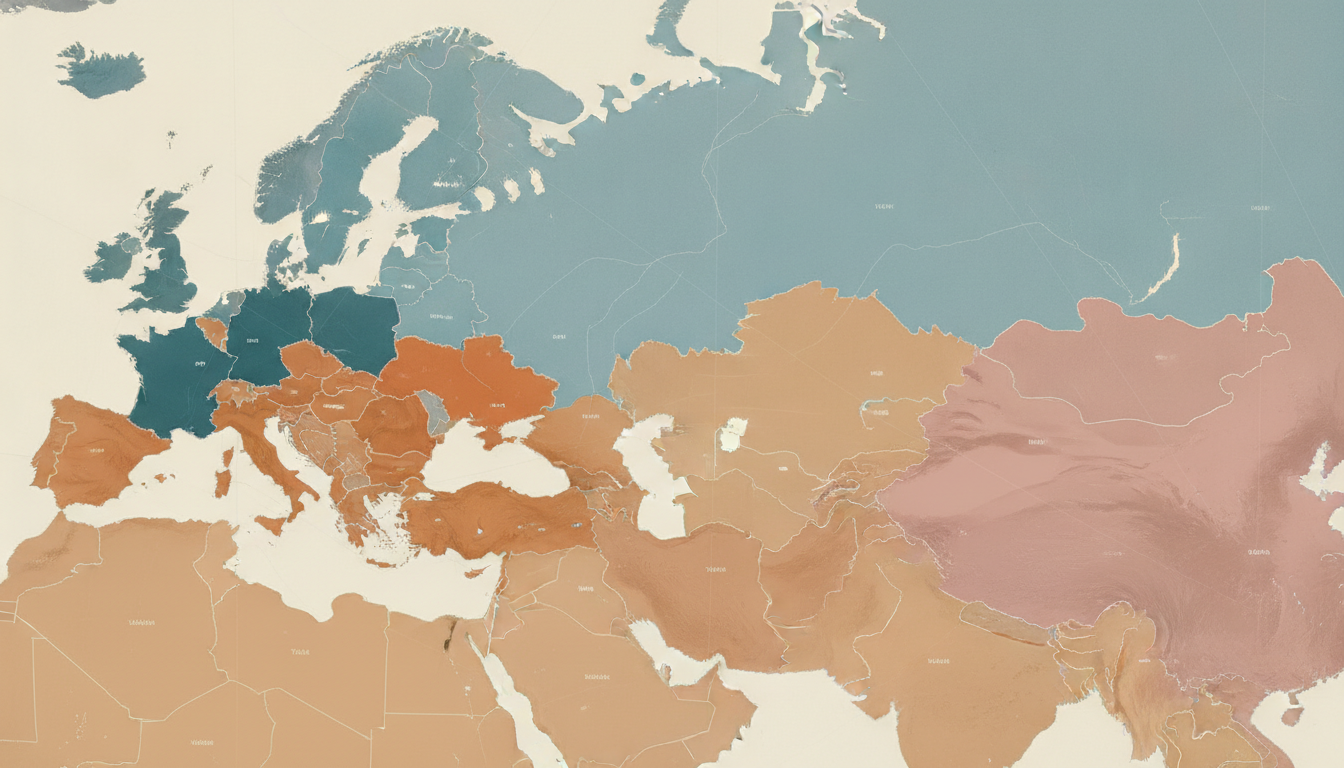
The geographic distribution of the Turkic Language Family is nothing short of breathtaking. Its speakers are found across an arc stretching over 6,000 kilometers from west to east and 4,000 kilometers from north to south. Major concentrations include Central Asia (Kazakhstan, Uzbekistan, Kyrgyzstan, Turkmenistan), the Caucasus (Azerbaijan), Anatolia (Turkey), parts of Eastern Europe (Crimea, Gagauzia), Siberia (Sakha/Yakutia), and western China (Xinjiang Uyghur Autonomous Region).
This vast distribution is a testament to the historical migrations, empires, and cultural exchanges of Turkic peoples over millennia. While some Turkic languages are official national languages, others maintain a strong regional presence, contributing to the rich linguistic diversity of their respective nations. As of 2026, the estimated total number of speakers for the entire Turkic Language Family exceeds 200 million, making it one of the world’s largest language families by total speakers.
Tracing the Roots: Proto-Turkic and Beyond
The journey of the Turkic Language Family begins with Proto-Turkic, the reconstructed common ancestor from which all modern Turkic languages are believed to have descended. Linguists generally place the homeland of Proto-Turkic in East Asia, likely in a region encompassing present-day Mongolia and Southern Siberia, sometime around 500-1000 BCE. The earliest written evidence of Turkic languages comes from the Orkhon Inscriptions in Mongolia, dating back to the 8th century CE, which are monumental texts of Old Turkic.
From this ancestral homeland, Turkic peoples and their languages spread through a series of migrations, conquests, and cultural diffusions. Key historical events like the expansion of the Hunnic, Göktürk, Uyghur, and later, the Seljuk and Ottoman empires, played crucial roles in dispersing Turkic languages across the Eurasian steppe and into new territories. This historical trajectory led to the diversification of Proto-Turkic into the numerous distinct languages we recognize today.
The internal coherence of the Turkic Language Family, despite its vast geographic spread, points strongly to a common linguistic ancestor that diversified over millennia through migration and contact with other language groups.
— Oxford Research Encyclopedia of Linguistics
Shared Linguistic DNA: Hallmarks of the Turkic Language Family
Despite their diversity, languages within the Turkic Language Family share several distinctive features that make them recognizable members of the same linguistic group. These characteristics provide a fascinating insight into their common ancestry and structural elegance.
Agglutination: Building Blocks of Meaning
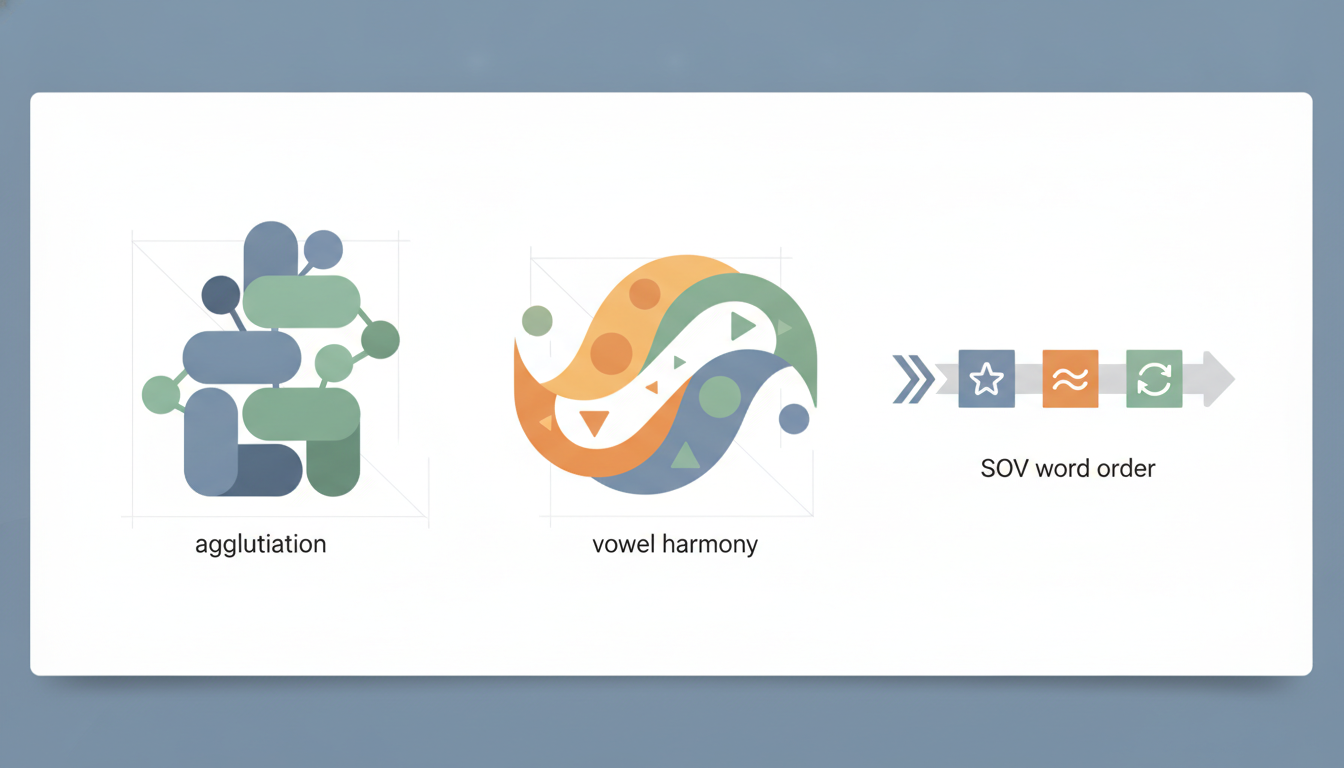
Perhaps the most prominent feature is agglutination. Turkic languages are highly agglutinative, meaning words are formed by adding numerous suffixes to a root word, each typically conveying a single grammatical meaning. There are very few, if any, prefixes. For example, in Turkish, ev (house) can become ev-ler-im-den (from my houses), with each suffix adding a distinct layer of meaning (plural, possessive, ablative case).
Vowel Harmony: A Melodious System
Vowel harmony is another defining phonological feature. This rule dictates that vowels within a word, particularly within a root and its suffixes, must belong to the same ‘class’ (e.g., all front vowels or all back vowels). This creates a rhythmic and melodic quality in pronunciation and helps maintain the phonetic integrity of words as suffixes are added. This principle is fundamental to the sound of languages like Turkmen and Kazakh.
Subject-Object-Verb (SOV) Word Order
Most Turkic languages follow a Subject-Object-Verb (SOV) word order, which places the verb at the end of a sentence. For instance, instead of "I read a book," a Turkic speaker would say, "I a book read." This structure influences how sentences are built and how information is presented.
Lack of Grammatical Gender
Unlike many Indo-European languages, Turkic languages do not typically distinguish grammatical gender for nouns or pronouns. The word for "he," "she," and "it" is often the same (e.g., o in Turkish), simplifying aspects of noun agreement but requiring context for gender identification.
Rich Derivational Morphology
Turkic languages possess a highly productive derivational morphology. This means that new words can be easily formed from existing roots by adding specific suffixes, creating a vast vocabulary from a relatively smaller set of core words. For example, from a verb root meaning ‘write,’ one can derive ‘writer,’ ‘writing,’ ‘able to write,’ ‘get written,’ and many more, all using distinct suffixes.
Classification and Debates: Sub-branches and Altaic Hypothesis
The internal classification of the Turkic Language Family is a complex field, with various models proposed by linguists. The most widely accepted classification divides the family into several main branches, typically based on phonological and lexical innovations. While the exact number and naming of these branches can vary, common divisions include:
- Oghuz (Southwestern) Turkic: Includes Turkish, Azerbaijani, Turkmen, Gagauz, and Qashqai. These languages share a high degree of mutual intelligibility.
- Kipchak (Northwestern) Turkic: Encompasses Kazakh, Kyrgyz, Tatar, Bashkir, Kumyk, Karachay-Balkar, and Nogai. Spoken primarily in Central Asia and the Volga-Ural region.
- Karluk (Southeastern) Turkic: Features Uzbek and Uyghur. Historically influential along the Silk Road.
- Siberian (Northeastern) Turkic: Includes Sakha (Yakut), Tuvan, Khakas, and Altai. Spoken in Siberia, often by smaller, indigenous groups.
- Oghur (Bulgar) Turkic: A distinct and often divergent branch, represented today mainly by Chuvash. Most other Oghur languages are extinct (e.g., Khazar, Volga Bulgar).
Beyond internal classification, the Turkic Language Family is often discussed in the context of the controversial "Altaic hypothesis." This hypothesis posits a larger linguistic superfamily that includes Turkic, Mongolic, Tungusic, Koreanic, and Japonic languages. However, the Altaic hypothesis remains highly contentious among linguists, with many arguing that the shared features are due to ancient language contact and borrowing rather than a common genetic origin. As of 2026, the consensus among many historical linguists is to treat the Turkic Language Family as a distinct, primary language family, without a definitive super-family connection to Altaic.
While some linguists have proposed a wider Altaic super-family, the prevailing academic view in 2026 tends to treat the Turkic Language Family as a primary, genetically unified language group, with historical contacts explaining many apparent similarities to other language families.
— Ethnologue (SIL International)
A Glimpse at Prominent Turkic Languages
The Turkic Language Family is home to numerous languages, each with its own rich history and cultural significance. Here are a few prominent examples:
- Turkish: The most widely spoken Turkic language, with over 80 million native speakers primarily in Turkey and Cyprus, and significant diaspora communities. It is the official language of Turkey and is a standard-bearer for the Oghuz branch.
- Azerbaijani: Spoken by approximately 25-35 million people, mainly in Azerbaijan and Iran. It is closely related to Turkish and shares a high degree of mutual intelligibility.
- Kazakh: An official language of Kazakhstan, with over 12 million speakers. Kazakh (Qazaq) is a prominent member of the Kipchak branch and is known for its strong nomadic heritage.
- Uzbek: Spoken by over 30 million people primarily in Uzbekistan and neighboring Central Asian countries. It belongs to the Karluk branch and has been heavily influenced by Persian.
- Uyghur: Spoken by roughly 11 million people in the Xinjiang Uyghur Autonomous Region of China, and parts of Central Asia. Uyghur (Uyghur) is another key member of the Karluk branch, known for its distinctive script and rich literary tradition.
- Turkmen: The official language of Turkmenistan, with about 7 million speakers. Turkmen is part of the Oghuz branch and maintains close ties to Turkish and Azerbaijani.
- Kyrgyz: Spoken by around 5 million people, mainly in Kyrgyzstan and neighboring regions. A member of the Kipchak branch, Kyrgyz has a rich oral tradition, including the epic Manas.
Preserving the Legacy: Challenges and Opportunities
While major Turkic languages like Turkish, Uzbek, and Kazakh are thriving, many smaller Turkic languages face significant challenges. Globalization, dominant national languages, and socio-economic pressures can lead to language shift and endangerment. Efforts to preserve and revitalize these languages are crucial for maintaining the linguistic and cultural diversity of the Turkic world.
Opportunities for preservation include digital archiving, language education initiatives, support for media and literature in minority languages, and the development of robust linguistic resources. Websites like TurkicLex play a vital role in this by making diverse Turkic languages more accessible and promoting comparative linguistic study. The ongoing work of linguists, educators, and community activists is essential to ensure the continued vitality of the entire Turkic Language Family.
Embarking on a Linguistic Journey: Learning Turkic Languages
For those inspired to learn a language from the Turkic Language Family, the journey offers immense rewards. Understanding a Turkic language opens doors to rich cultural histories, diverse literatures, and direct communication with millions across Eurasia. Given their shared features, learning one Turkic language often provides a substantial head start for learning another, as common vocabulary and grammatical structures reappear across the family.
Whether you’re interested in Turkish for travel, Kazakh for business, or Uyghur for academic research, resources are increasingly available. Online platforms, textbooks, and communities offer pathways to proficiency. Exploring common vocabulary themes, such as human body vocabulary or food and drink terms, can highlight the fascinating similarities and differences within the family. Don’t be afraid to suggest a language if you notice a gap in available resources!
Common Misconceptions About the Turkic Language Family
Despite its prominence, the Turkic Language Family is often subject to misunderstandings. One common misconception is that "Turkic" simply refers to modern Turkish. As we’ve discussed, Turkish is just one member, albeit a very important one. Another is the assumption that all Turkic speakers are ethnically "Turk" in the modern sense; while there’s a historical connection, identity is complex and encompasses various ethnicities. Some also incorrectly assume that Turkic languages are grammatically simple due to agglutination; in reality, their morphology is complex and requires careful study.
Finally, the idea that Turkic languages are "isolated" or "exotic" is far from the truth. They have been central to numerous empires and cultural spheres, interacting extensively with Indo-European, Sino-Tibetan, and Uralic languages throughout history, leading to mutual influence and lexical borrowing. Dispelling these myths helps foster a more accurate and nuanced appreciation of this vibrant language group.
Conclusion
The Turkic Language Family stands as a monumental testament to linguistic diversity and historical resilience. From its reconstructed Proto-Turkic origins to its vast modern-day distribution, and from its agglutinative grammar to its melodic vowel harmony, it offers a compelling field of study for anyone interested in human communication. Understanding the Turkic Language Family is not merely an academic exercise; it’s an exploration of shared heritage, a bridge between cultures, and an appreciation of the profound interconnectedness of our world. We invite you to continue your linguistic journey and delve deeper into Turkic languages with TurkicLex.
Frequently Asked Questions (FAQ)
- Q: Are all Turkic languages mutually intelligible?
- A: No, while closely related languages within the same branch (e.g., Turkish and Azerbaijani) often have high mutual intelligibility, languages from different branches may be mutually unintelligible.
- Q: Is the Turkic Language Family related to the Uralic languages (Finnish, Hungarian)?
- A: The proposed Ural-Altaic hypothesis, linking Turkic and Uralic languages, is largely rejected by mainstream linguists due to a lack of robust evidence for genetic relatedness, despite some superficial similarities.
- Q: What is the most widely spoken Turkic language?
- A: Turkish, primarily spoken in Turkey, is the most widely spoken language within the Turkic Language Family by native speakers.
- Q: Do Turkic languages use the Latin alphabet?
- A: Many Turkic languages, including Turkish, Azerbaijani, and Uzbek, primarily use modified Latin alphabets, while others like Kazakh and Kyrgyz still use Cyrillic, and Uyghur uses an Arabic-derived script.
- Q: Where can I find resources to learn a Turkic language?
- A: You can find various resources on platforms like TurkicLex, which offers vocabulary and comparative tools, alongside textbooks, online courses, and language exchange communities.
Ready to Explore More?
Expand your linguistic horizons. Whether you’re a seasoned linguist or a curious beginner, TurkicLex is your comprehensive portal to the diverse world of Turkic languages. Explore vocabulary, delve into grammar, and connect with a community passionate about these fascinating tongues.