

Understanding Vowel Harmony in Turkic Languages: A Comparative Linguistic Journey
Vowel harmony is a core phonological rule in Turkic languages where all vowels within a word, including suffixes, must share certain phonetic qualities, primarily related to their frontness/backness and sometimes rounding. This essential linguistic phenomenon dictates how words are built and how suffixes attach, creating a melodic consistency that is a hallmark of the Turkic linguistic family.
The Phonological Foundation of Vowel Harmony in Turkic Languages
At its heart, vowel harmony ensures phonetic cohesion within a word. It categorizes vowels based on their articulation point in the mouth: front vowels (e.g., /i, e, ü, ö/) are produced towards the front of the mouth, while back vowels (e.g., /ı, a, u, o/) are produced towards the back. Some systems also consider lip rounding (rounded vs. unrounded) and vowel height (high vs. low). When a word root contains front vowels, subsequent suffixes will also adopt front vowels, and similarly for back vowels. This principle applies not only to root words but extends dynamically to all added affixes, making it a critical aspect of morphology.
Understanding these phonetic distinctions is fundamental for any learner or linguist engaging with Turkic languages. It isn’t merely a decorative feature; it’s a structural imperative that governs phonology and morphology, profoundly influencing pronunciation and even the perceived ‘sound’ of these languages. Mastery of vowel harmony is thus a gateway to both speaking and comprehending Turkic languages authentically.
Primary Types of Vowel Harmony Systems
While the fundamental concept of vowel harmony is universal across most Turkic languages, its specific manifestation can vary. The most common system is two-fold harmony, primarily distinguishing between front and back vowels. Many languages, however, also incorporate a more complex four-fold harmony, which further considers vowel rounding and height, often seen in the adaptation of certain suffixes. Not all Turkic languages apply these rules with equal rigidity; some dialects or languages exhibit partial harmony or have undergone historical changes that introduce exceptions, particularly concerning loanwords.
The degree of complexity can range from relatively straightforward back-front harmony, as seen predominantly in Turkish, to more intricate systems in languages like Kazakh or Kyrgyz, where lip rounding plays an equally significant role. Recognizing these systemic variations is key to appreciating the linguistic diversity within the Turkic family and provides valuable insight into comparative Turkic phonology.
Case Study 1: Azerbaijani’s Consistent Application
Azerbaijani exemplifies a robust and consistent application of vowel harmony, primarily following the front/back distinction. Suffixes adapt their vowels to match the final vowel of the root word. For instance, the plural suffix has two forms: -lar for back-vowel words and -lər for front-vowel words. Consider the word for ‘book’, kitab (back vowel in final syllable), which becomes kitablar (‘books’). Conversely, ‘hand’ is əl (front vowel), becoming əllər (‘hands’).
This systematic adaptation extends to all grammatical suffixes, ensuring phonological coherence. Even when dealing with concepts like family members, the pattern holds: ana (‘mother’) takes analar, while gözəl (‘beautiful’ – often used for people) takes gözəllər. This predictability makes Azerbaijani’s grammar highly regular in this regard, offering a clear entry point for understanding the principle of vowel harmony.
Case Study 2: Turkish – A Paradigmatic Example
Turkish is often cited as a prime example of a language with comprehensive vowel harmony, encompassing both major (front/back) and minor (rounded/unrounded) rules. The major vowel harmony dictates that all vowels in a word must be either front or back. For instance, ‘house’ (ev) has a front vowel, so its plural is evler. ‘Door’ (kapı) has a back vowel, so its plural is kapılar.
The minor vowel harmony further refines this, especially for high vowels (i, ı, u, ü), considering rounding. For example, the dative case suffix has four forms: -a, -e, -ya, -ye, determined by the preceding vowel. The locative case suffix also has two forms: -da/-de, again adhering to front/back harmony. This intricate system is a cornerstone of Turkish phonology and a fundamental aspect for anyone looking to master the language. Engaging with the best Turkic dictionaries often provides ample examples illustrating these rules.
Case Study 3: Kazakh and Kyrgyz – Beyond Front/Back
Kazakh and Kyrgyz exhibit a particularly pronounced form of vowel harmony that extends beyond simple front/back distinctions to include significant lip rounding. In these languages, not only do vowels harmonize by palatalization (front/back), but also by labialization (rounded/unrounded), especially for non-high vowels. This means a word starting with a rounded vowel will typically continue with rounded vowels in subsequent syllables and suffixes, provided they are in the same harmony class.
For example, in Kazakh, ‘city’ is qala (back, unrounded), plural is qalalar. But ‘eye’ is köz (front, rounded), plural is közder. The plural suffix -lar/-ler adapts not only to front/back but sometimes to rounding in more complex derivations. This adds an additional layer of complexity compared to Turkish or Azerbaijani, making phonetic precision crucial for learners.
Vowel harmony, particularly its palatal and labial varieties, represents a defining typological characteristic of the Turkic language family, significantly shaping their agglutinative morphology.
Case Study 4: Uyghur’s Unique Manifestations
Uyghur, spoken predominantly in Xinjiang, China, also demonstrates vowel harmony, though its system has some unique characteristics and potential for variations. While the front/back distinction is generally maintained, the strictness can sometimes be influenced by loanwords, particularly from Arabic and Persian, which may break harmony within a word. However, native Uyghur words and their suffixes consistently adhere to the rules.
For instance, the plural suffix -lar/-lər follows the standard front/back rule, similar to Turkish and Azerbaijani. ‘Boy’ is oğul (back), becoming oğullar (‘boys’). ‘Girl’ is qiz (front), becoming qizlar (‘girls’). The impact of historical sound changes and contact with other languages means that while the principle is strong, learners of Uyghur should be aware of nuances, particularly in highly-persianized or arabized vocabulary.
Case Study 5: Turkmen – Vowel Harmony with Nuances
Turkmen, primarily spoken in Turkmenistan, presents a vowel harmony system that aligns broadly with other Oghuz Turkic languages but also exhibits certain specific nuances. It predominantly employs a front/back distinction for vowel harmony, with suffixes adapting accordingly. For example, ‘house’ is öý (front), plural öýler. ‘Friend’ is dost (back), plural dostlar.
While labial harmony (rounding) is less pervasive than in some Central Asian Turkic languages, it still plays a role in certain suffix forms and derivations. Learners of Turkmen will find its system generally consistent, but occasional exceptions or slightly different applications, especially in specific grammatical contexts or among regional dialects, highlight the rich diversity within the broader Turkic family.
Comparative Table: Vowel Harmony Across Key Turkic Languages
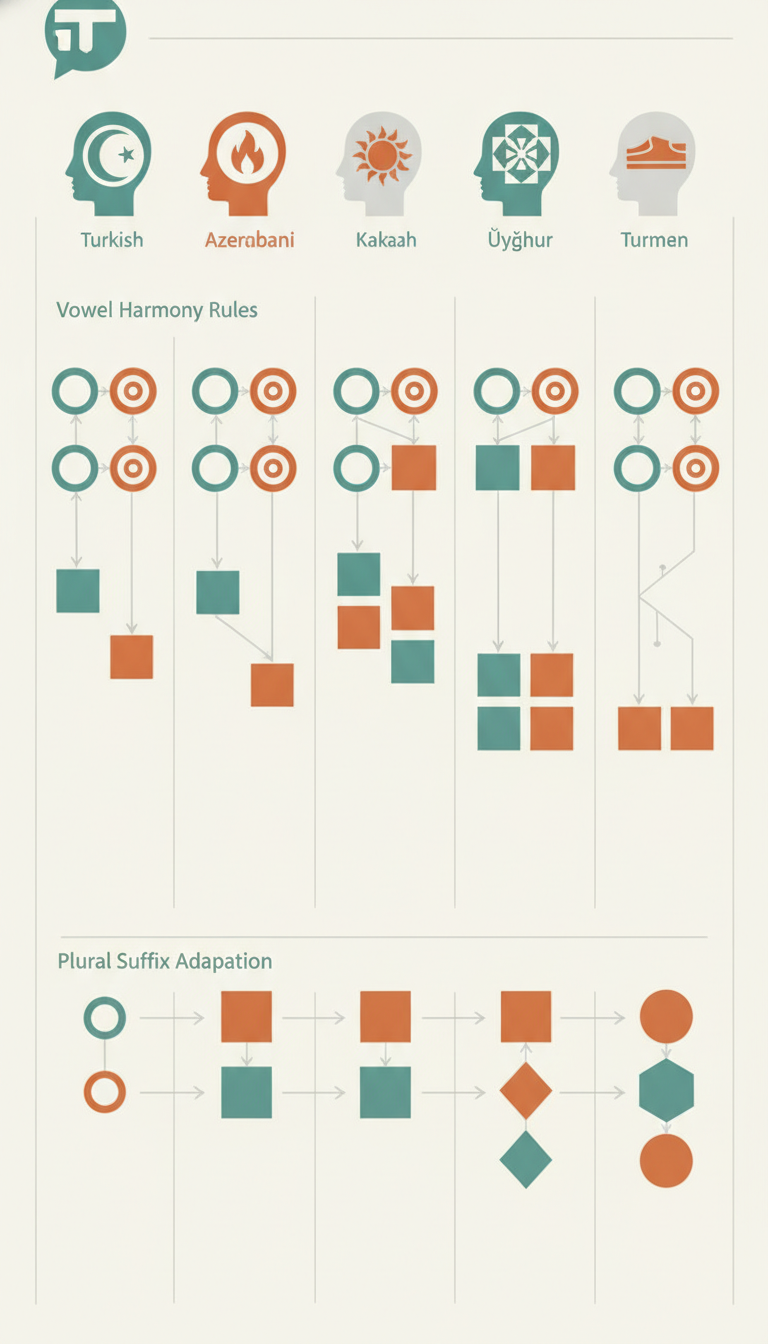
This table summarizes how vowel harmony manifests in the Turkic languages discussed, highlighting their commonalities and distinctions. It primarily focuses on the front/back harmony, which is the most widespread, and notes additional complexities like rounding where relevant. Understanding these differences is crucial for comparative linguistics and for learners approaching multiple Turkic languages.
| Language | Primary Harmony Type | Suffix Adaptation Example (Plural) | Notes on Complexity/Exceptions |
|---|---|---|---|
| Azerbaijani | Front/Back (Two-fold) | -lar / -lərkitab-lar, əl-lər |
Highly consistent, few exceptions for native words. |
| Turkish | Front/Back + Rounded/Unrounded (Four-fold) | -lar / -lerkapı-lar, ev-ler |
Very strict; includes minor harmony for high vowels. |
| Kazakh | Front/Back + Rounded/Unrounded (Complex) | -lar / -ler / -dar / -der / -tar / -terqala-lar, köz-der |
Strong labial harmony; multiple allomorphs for suffixes. |
| Uyghur | Front/Back (Two-fold) | -lar / -ləroğul-lar, qiz-lar |
Generally consistent, some influence from loanwords. |
| Turkmen | Front/Back (Two-fold) | -lar / -lerdost-lar, öý-ler |
Mainly front/back; minor labial harmony in specific contexts. |
Challenges and Exceptions in Vowel Harmony
While vowel harmony is a defining characteristic, it’s not without its complexities and exceptions. The most significant challenge arises from loanwords, particularly those from Arabic, Persian, and more recently, European languages. Many loanwords retain their original vowels, which may not conform to Turkic harmony rules. In such cases, suffixes usually harmonize with the *last* vowel of the loanword, or in some instances, adopt a default harmony form.
Compound words can also present complexities, with their components often retaining their original vowel harmony, leading to a word that appears to break harmony across the compound boundary. Furthermore, some languages or dialects have undergone historical shifts, resulting in certain irregular words or fixed suffixes that no longer adhere to the standard rules. Awareness of these exceptions is vital for advanced learners and linguists.
While vowel harmony is a widespread feature in Turkic languages, its historical application and contemporary manifestation can vary, especially under the influence of extensive lexical borrowing from non-Turkic sources.
Pedagogical Implications for Language Learners
For anyone embarking on a Turkic language journey, understanding and internalizing vowel harmony is paramount. It’s not a rule to be merely memorized but a pattern to be felt and practiced. Beginners often find it challenging initially, but consistent exposure and practice with conjugation and declension drills quickly build intuition. Rather than focusing on abstract rules, observing patterns in real words and phrases is more effective. For example, when learning daily action verbs, pay attention to how suffixes like ‘-iyor’ in Turkish (present continuous) or ‘-ajak/-ejeğ’ (future tense) adapt their vowels. Utilizing audio resources and practicing speaking aloud helps engrain the correct phonetic responses, transforming a complex rule into an intuitive part of language production.
Conclusion: The Enduring Harmony of Turkic Languages
Vowel harmony stands as one of the most distinctive and fascinating features of the Turkic language family. It is a testament to the elegant internal consistency that governs these agglutinative languages, influencing every aspect of their phonology and morphology. From the relatively straightforward systems of Azerbaijani and Turkmen to the more intricate patterns found in Turkish, Kazakh, and Kyrgyz, vowel harmony underscores the shared linguistic heritage while also highlighting unique evolutionary paths.
For learners, it is the rhythmic heart of the language; for linguists, it offers a rich field of study into phonetic interaction and morphological adaptation. Mastering vowel harmony is not just about memorizing rules; it is about grasping the very essence of how Turkic languages ‘sound’ and ‘work’, unlocking a deeper appreciation for their structure and beauty.
Frequently Asked Questions (FAQ)
- Q1: Is vowel harmony present in all Turkic languages?
- Most Turkic languages exhibit some form of vowel harmony, though its strictness and specific rules can vary significantly across the family.
- Q2: How do loanwords affect vowel harmony?
- Loanwords often present exceptions to vowel harmony rules; suffixes usually harmonize with the last vowel of the loanword, or a default form is used.
- Q3: Is vowel harmony a unique feature of Turkic languages?
- No, while prominent in Turkic, vowel harmony also appears in other language families like Uralic (e.g., Finnish, Hungarian), Mongolic, and some Tungusic languages.
- Q4: What is the easiest way to learn vowel harmony?
- Consistent practice with listening and speaking, focusing on observing how suffixes adapt to different word roots, is more effective than rote memorization of rules.
- Q5: Does vowel harmony apply to compound words?
- Generally, each component of a compound word maintains its internal vowel harmony, though the junction between the components may not always follow harmony rules.
Deepen Your Turkic Language Journey with TurkicLex
The intricate dance of vowels within Turkic words is just one aspect of these rich and diverse languages. If this exploration of vowel harmony has sparked your curiosity, TurkicLex is your comprehensive resource for diving deeper. From exploring essential vocabulary related to body parts to understanding the nuances of different dialects, our platform offers a wealth of tools and information.
Continue your linguistic adventure by browsing our extensive wordlists, comparing various dictionaries, and discovering more articles that illuminate the fascinating world of Turkic languages. Whether you’re a beginner or an advanced linguist, TurkicLex provides the pathways to enhance your knowledge and connection to this vibrant linguistic family.