
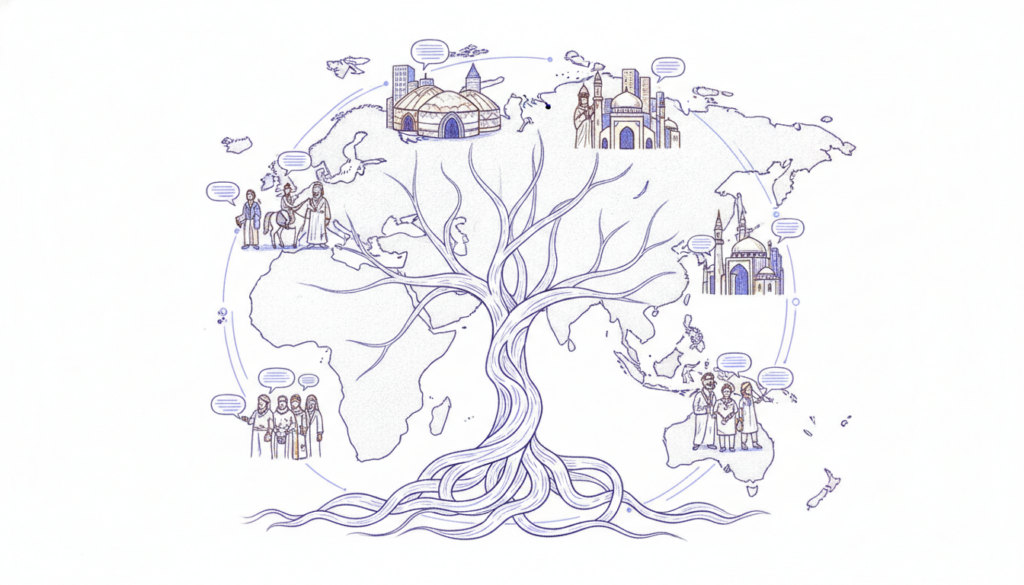
A Turkic speaking population refers to communities across Eurasia that communicate using any of the approximately 35 to 40 distinct languages belonging to the Turkic language family. Spanning an expansive territory from Southeastern Europe through Central Asia to Northeastern Siberia, these speech communities share core structural traits, including agglutinative morphology, regular vowel harmony, and Subject-Object-Verb word order.
Understanding the geographic and genealogical distribution of these languages helps linguists, researchers, and learners navigate a language family that connects over 170 million native speakers globally. Whether analyzing literary traditions, historical migration patterns, or modern dialect continua, comparing the major branches provides a clear roadmap for study.
Glottolog classifies the Turkic language family as a primary language group divided into distinct genealogical branches, encompassing both Western and Eastern divisions across Eurasia.
Major Turkic Speaking Branches at a Glance
The Turkic language family is conventionally organized into six principal branches: Oghuz (Southwestern), Kipchak (Northwestern), Karluk (Southeastern), Siberian (Northeastern), Oghur (Bulgar), and Arghu. The vast majority of living speakers belong to the first three branches, while Siberian and Oghur languages offer critical historical insights for comparative linguistics.
The table below summarizes the key demographic, geographic, and structural differences across the primary sub-families.
| Branch | Key Languages | Primary Regions | Distinctive Feature | Mutual Intelligibility |
|---|---|---|---|---|
| Oghuz (Southwestern) | Turkish, Azerbaijani, Turkmen, Gagauz | Turkey, Azerbaijan, Turkmenistan, Balkans, Iran | Initial consonant voicing (/k/ > /g/, /t/ > /d/) | High within the branch |
| Kipchak (Northwestern) | Kazakh, Kyrgyz, Tatar, Bashkir, Karakalpak | Kazakhstan, Kyrgyzstan, Volga region, Caucasus | Shift of /ʃ/ to /s/ and initial /dʒ/ or /ʒ/ | High within sub-groups |
| Karluk (Southeastern) | Uzbek, Uyghur | Uzbekistan, Xinjiang (China), Central Asia | Historical Chagatai influence; vowel rounding in Uzbek | Very high between Uzbek and Uyghur |
| Siberian (Northeastern) | Sakha (Yakut), Tuvan, Altay, Khakas | Siberia, Sakha Republic, Tuva Republic (Russia) | Preservation of archaic traits; extensive contact influences | Low to moderate outside subgroup |
| Oghur (Bulgar) | Chuvash | Chuvashia (Volga River basin, Russia) | R-Turkic branch (/r/ corresponding to common Turkic /z/) | Low with Common Turkic |
The Oghuz Branch: The Largest Turkic Speaking Demographic
The Oghuz or Southwestern branch represents the largest proportion of total Turkic speakers worldwide, accounting for over 100 million individuals. The primary languages in this group include Turkish, Azerbaijani, Turkmen, and Gagauz.
A defining phonological trait of the Oghuz group is the voicing of initial voiceless stops. Where older Common Turkic roots featured initial /k/ or /t/, Oghuz languages typically exhibit /g/ and /d/. For instance, the root word for “lake” appears as göl in Turkish and Azerbaijani, contrasted with köl in Kipchak tongues.
Speakers within the Oghuz group enjoy significant mutual intelligibility. A native speaker of Turkish can generally comprehend standard Azerbaijani with minimal practice, owing to shared grammatical suffixes, overlapping core vocabulary, and continuous media exchange. You can explore full conjugation patterns and lexical entries in the Turkish language guide.
The Kipchak Branch: The Steppe Linguistic Group
Extending across the vast Eurasian steppe from Eastern Europe to the Altay Mountains, the Kipchak or Northwestern branch includes Kazakh, Kyrgyz, Tatar, Bashkir, Karakalpak, and Nogai. This group reflects historical nomadism and regional interactions across the Golden Horde territories.
Phonologically, Kipchak languages exhibit notable sound correspondences. One of the most prominent shifts involves the sibilant consonant /ʃ/ (the “sh” sound), which frequently shifts to /s/ in Kazakh and Karakalpak. For example, the common Turkic word for “stone” (taş in Turkish) becomes tas in Kazakh.
Linguists further divide Kipchak into three sub-branches:
- Kipchak-Bulgar: Tatar and Bashkir, heavily concentrated around the Volga-Ural region.
- Kipchak-Cuman: Crimean Tatar, Karachay-Balkar, and Kumyk, showing historical Oghuz influence.
- Kipchak-Nogai: Kazakh, Kyrgyz, Karakalpak, and Nogai, characterized by specific phonetic shifts.
Learners studying languages like Kazakh will find rich cases of complex vowel harmony systems and distinct nominal declensions detailed in our Kazakh language profile.
The Karluk Branch: Central Asian Cultural Crossroads
The Karluk or Southeastern branch comprises Uzbek and Uyghur, serving as the historical linguistic bridge along the ancient Silk Road routes. Historically developing from Chagatai—the classical literary language of Islamic Central Asia—Karluk languages possess a deep written literary heritage.
Uzbek is the official language of Uzbekistan and ranks as the second most widely spoken Turkic language, with over 30 million native speakers. Uyghur is spoken primarily in the Xinjiang Uyghur Autonomous Region of China and across diaspora communities in Central Asia.
One distinct feature of standard urban Uzbek is the loss of strict front-back vowel harmony, influenced by centuries of close contact with Tajik (an Iranian language). Despite this phonetic evolution, standard Uzbek and Uyghur retain remarkable structural similarities, allowing high levels of mutual comprehension between their speakers. To trace the evolution of Chagatai into modern Karluk dialects, review our detailed guide on unraveling the Turkic language family.
Wikipedia notes that the Turkic languages form a language family of at least 35 documented languages, spoken by Turkic peoples across broad territories stretching from Eastern Europe to Siberia and Western China.
Siberian and Oghur Branches: Divergent Paths in Turkic Linguistics
The Siberian (Northeastern) branch and the Oghur (Bulgar) branch contain languages that diverged early from the Proto-Turkic main stem. These languages provide invaluable evidence for historical-comparative linguistics.
The Siberian Branch
The Siberian branch includes Sakha (Yakut), Tuvan, Altay, Khakas, and Shor. Sakha, spoken in the Sakha Republic (Yakutia), is isolated from the main Turkic dialect continuum and has incorporated significant Tungusic and Mongolic vocabulary, alongside unique sound changes such as the loss of initial /s/.
The Oghur Branch and Chuvash
Chuvash is the sole surviving representative of the Oghur branch, spoken in the Volga region of Russia. Unlike all other living Turkic languages (collectively termed “Common Turkic”), Chuvash exhibits “r-Turkic” features. Where Common Turkic languages use /z/, Chuvash utilizes /r/. For example, the word for “nine” is dokuz in Turkish, but tăḫăr in Chuvash.
Comparative Lexical Examples Across Five Languages
To observe how cognates shift across branches, consider standard vocabulary terms across representative languages from each major group: Turkish (Oghuz), Kazakh (Kipchak), Uzbek (Karluk), Turkmen (Oghuz), and Sakha/Yakut (Siberian).
| English Meaning | Turkish (Oghuz) | Kazakh (Kipchak) | Uzbek (Karluk) | Sakha (Siberian) |
|---|---|---|---|---|
| Water | su | su / су | suv | uu / уу |
| Eye | göz | kóz / көз | ko’z | kös / күөһэ |
| Five | beş | bes / бес | besh | biès / биэс |
| Hand / Arm | el / kol | qol / қол | qo’l | ilii / илии |
| Head | baş | bas / бас | bosh | bas / бас |
Notice how the root for “five” displays regular phonetic evolution: Turkish beş, Kazakh bes, Uzbek besh, and Sakha biès. You can analyze additional comparative sets across hundreds of entries using our interactive word comparison tool.
Analyzing Sound Shifts Across Turkic Branches
Core Structural Traits of Turkic Speaking Languages
Despite geographical dispersion, almost every Turkic speaking group maintains fundamental typological features that make the family exceptionally regular.
- Agglutinative Morphology: Words are formed by attaching distinct, single-function suffixes to invariant roots. Stacking suffixes allows speakers to convey complex spatial, temporal, and modal relationships in a single word.
- Strict Vowel Harmony: Vowels within a single native word harmonise based on tongue position (front vs. back) and lip rounding (rounded vs. unrounded).
- Lack of Grammatical Gender: Turkic languages do not assign gender to nouns, pronouns, or adjectives. The third-person pronoun (e.g., o in Turkish, ol in Kazakh) translates universally as he, she, or it.
- Subject-Object-Verb (SOV) Word Order: Modifiers consistently precede the heads they modify, placing verbs firmly at the clause sentence end.
To inspect comprehensive grammar breakdowns across all regional branches, browse our dedicated Turkic languages catalog.
Choosing a Turkic Language to Study: Strategic Recommendations
When deciding which language to learn, consider your specific goals across research, trade, or cultural immersion:
- For Commercial and Travel Accessibility: Choose Turkish or Azerbaijani. The Oghuz group provides immediate access to large economic hubs, modern media, and extensive learning resources.
- For Central Asian Regional Focus: Choose Uzbek or Kazakh. Uzbek provides a doorway to Silk Road history and Central Asian commerce, while Kazakh opens doors across Northern Eurasia.
- For Historical-Comparative Linguistics: Choose Sakha (Yakut) or Chuvash. Studying these divergent branches reveals archaisms critical for reconstructing ancestral Proto-Turkic forms.
Explore Turkic Linguistics with TurkicLex
Ready to deepen your vocabulary and compare grammar across Eurasian speech communities? Take advantage of our interactive linguistic tools to expand your knowledge.
Search TurkicLex Now |
Explore All 9 Turkic Languages |
Compare Words Across Turkic Languages |
Contribute to the Community |
Start Learning a Turkic Language
Frequently Asked Questions
How many Turkic speaking people are there in the world?
There are approximately 170 to 180 million native speakers across Eurasia, with the largest concentration speaking Turkish, Azerbaijani, Uzbek, and Kazakh.
Are Turkic languages mutually intelligible with one another?
Mutual intelligibility is high within the same branch—such as between Turkish and Azerbaijani or Uzbek and Uyghur—but decreases significantly when comparing distant branches like Oghuz and Siberian Turkic.
Which Turkic language is easiest to learn for English speakers?
Turkish is generally considered the most accessible due to its complete Latin alphabet, regular spelling rules, and abundance of modern learning materials.
What is the primary difference between Oghuz and Kipchak languages?
Oghuz languages frequently voice initial voiceless stops (e.g., /k/ becomes /g/), whereas Kipchak languages retain voiceless stops and exhibit specific sibilant shifts like /ʃ/ becoming /s/.
Why is Chuvash so different from other Turkic languages?
Chuvash belongs to the separate Oghur branch, which split earliest from ancestral Proto-Turkic, preserving unique “r-Turkic” sound shifts where other branches developed “z-Turkic” sounds.