
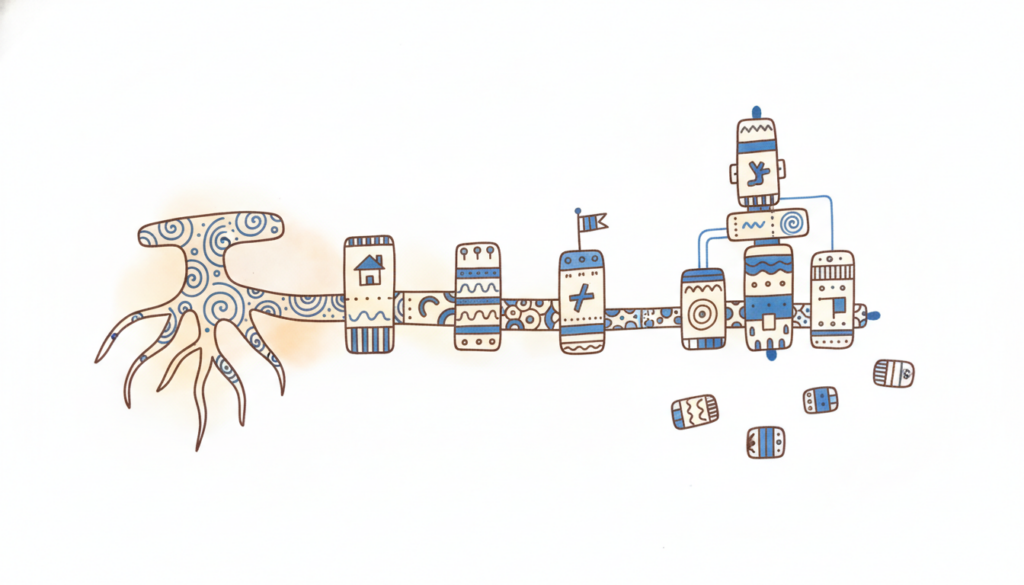
Agglutination in Turkic languages is a structural grammatical system where distinct, single-function suffixes attach sequentially to an immutable root word to express complex semantic relationships, possessive states, tenses, and spatial cases. Unlike inflectional languages such as Latin or Russian—where a single suffix frequently fuses multiple grammatical markers together while altering the root stem—Turkic agglutinative morphology keeps every core root recognizable while adding transparent, predictable suffixes step by step.
For students, academic linguists, and heritage speakers, understanding how agglutination functions provides the master key to decoding vocabulary across the entire Turkic family. Once you understand how root stems interact with suffix chains, complex words that initially look like endless walls of text instantly turn into logical, predictable strings of information.
What Is Agglutination in Turkic Languages?
The term agglutination originates from the Latin verb agglutinare, meaning “to glue together.” In comparative linguistics, languages are broadly categorized by how they construct words and express grammatical relationships: isolating, inflectional (fusional), and agglutinative.
In isolating languages like Mandarin Chinese, words remain fixed monosyllabic units, and grammatical relationships rely almost entirely on rigid word order. In fusional languages like Spanish, German, or Russian, a single word ending often packs person, number, tense, and case into one modified suffix. For instance, in Spanish, the single ending -ó in habló indicates third-person, singular, past tense, and indicative mood simultaneously, while altering how the stem functions.
By contrast, agglutination in Turkic languages operates like modular building blocks. The core root stem carries the basic semantic meaning and remains virtually unchanged. Grammatical modifications—such as pluralization, possession, location, modality, or negation—are appended behind the root in a single, orderly chain. Each individual suffix performs one primary job.
Agglutinative languages concatenate suffixes to invariant roots, where each suffix typically represents a single grammatical feature without altering the root’s base meaning.
Because each suffix maintains a distinct function, a reader or listener can easily dissect even a 30-letter word into its component parts. This structural clarity allows speakers to express entire English sentences within a single, elegantly structured word unit.
The Anatomy of a Turkic Word: Roots, Stems, and Morpheme Boundaries
To analyze Turkic word structure, linguists divide words into morphemes—the smallest meaningful units of language. In any Turkic word, morphemes align cleanly along transparent boundaries, creating predictable structural chains.
Every agglutinative word begins with a root stem. Whether you are analyzing southwestern Oghuz tongues like Turkish or northeastern languages like Tuvan, root words function as sturdy anchors. Suffixes are generally categorized into two functional classes:
- Derivational Suffixes: These affixes attach directly to the root stem to create entirely new words or alter the word’s grammatical class (e.g., transforming a noun into a verb or an adjective into a noun).
- Inflectional Suffixes: These affixes attach after any derivational suffixes to mark relationships like number, ownership, tense, mood, and spatial case without changing the underlying category of the word.
Consider the noun root göz (“eye”) in Turkish. By applying derivational and inflectional suffixes sequentially, we observe clear morpheme boundaries at every addition:
| Stage | Word Form | Morpheme Breakdown | English Translation |
|---|---|---|---|
| Root Noun | göz | göz | eye |
| Derivational | gözlük | göz + lük | eyeglasses (device for eyes) |
| Derivational #2 | gözlükçü | göz + lük + çü | optician (seller of eyeglasses) |
| Plural Inflection | gözlükçüler | göz + lük + çü + ler | opticians |
| Possessive Inflection | gözlükçülerimiz | göz + lük + çü + ler + imiz | our opticians |
| Case Inflection | gözlükçülerimizden | göz + lük + çü + ler + imiz + den | from our opticians |
Notice how each addition builds upon the previous state without distorting the initial stem göz. This structural stability makes reading and listening in Turkic languages highly systematic once you memorize the standard suffix hierarchy.
The Mechanics of Suffix Stacking: Sequential Grammar in Action
Suffix stacking follows a strict canonical order across the Turkic family tree. You cannot randomly attach endings; morphemes must follow a predetermined sequence based on their grammatical hierarchy.
When constructing nominal forms (nouns and adjectives), the standard ordering hierarchy across modern languages like Turkish, Uzbek, Kazakh, and Tatar strictly adheres to this path:
- Root Stem: Noun, verb, or adjective base.
- Derivational Affix: Modifies the semantic class or function of the root.
- Plural Marker: Indicates grammatical number (e.g., -lar / -ler).
- Possessive Marker: Identifies ownership (1st, 2nd, or 3rd person).
- Case Marker: Marks spatial or syntactic function (dative, accusative, locative, ablative, genitive).
- Relative or Clitic Particle: Adds additional context, such as -ki (“that which is at/in”) or question particles.
To see this rule set in practical action, consider the single Kazakh word достықтарымыздан (dostyqtarymyzdan), meaning “from our friendships”:
- дос (dost): Noun root meaning “friend”.
- -тық (-tyq): Derivational suffix turning “friend” into abstract noun “friendship”.
- -тар (-tar): Plural suffix adapted phonetically to “friendships”.
- -мыз (-myz): 1st person plural possessive marker (“our”).
- -дан (-dan): Ablative case suffix indicating movement away (“from”).
When you learn to learn Turkish suffix patterns or analyze Central Asian Turkic morphology, training your brain to scan from left to right along this sequential chain turns complex sentence structure into an intuitive mental process.
The 5 Steps of Turkic Suffix Stacking
Vowel Harmony: The Acoustic Glue Holding Suffixes Together
How do long agglutinative chains remain fluent and easy to pronounce? The answer lies in vowel harmony. Vowel harmony is the acoustic ruleset that dictates which form a suffix takes when attached to a given stem.
In Turkic morphology, vowels are classified along two primary phonetic axes:
- Back vs. Front Vowels: Back vowels (a, ı, o, u) are produced in the back of the vocal tract, while front vowels (e, i, ö, ü) are produced near the front.
- Unrounded vs. Rounded Vowels: Lips are either relaxed (a, e, ı, i) or rounded (o, ö, u, ü).
When a suffix is appended to a stem, its internal vowel must shift to match the vocalic quality of the preceding syllable. This means that while suffixes have a single underlying grammatical function, they exist in multiple surface variations.
For a detailed look at how vocalic classes govern word construction, explore our guide on understanding vowel harmony in Turkic languages. Below is an example of two-way vowel harmony using the plural suffix in Turkish and Azerbaijani:
| Root Vowel Type | Root Example | Harmonized Suffix | Final Word | Meaning |
|---|---|---|---|---|
| Back Vowel (a, ı, o, u) | at (horse) | -lar | atlar | horses |
| Front Vowel (e, i, ö, ü) | ev (house) | -ler | evler | houses |
In addition to vowel harmony, consonant assimilation occurs at morpheme boundaries. When a root ends in a voiceless consonant (like k, t, p, ç), the following suffix often adapts its initial consonant to maintain effortless articulation (for instance, changing -den to -ten in Turkish or altering plural markers in Kazakh to -tar/-ter or -dar/-der).
Cross-Turkic Agglutination Comparison: Turkish, Kazakh, Uzbek, and Tatar
Although agglutination defines morphological structure across the entire family, individual languages have evolved unique phonetic variations and orthographic conventions. Comparing how the sentence “in our houses” is formed across distinct sub-branches demonstrates both deep structural unity and distinct dialectal sound changes.
The Turkic language family is characterized by high morphological synthesis and strict agglutinative suffixation, retaining highly regular paradigms across geographically distant member languages.
Let’s examine how the phrase “in our houses” is constructed from the common root for “house” across four major living languages representing Oghuz, Kipchak, and Karluk branches:
| Language | Branch | Word Form | Morpheme Breakdown | Grammatical Analysis |
|---|---|---|---|---|
| Turkish | Oghuz | evlerimizde | ev + ler + imiz + de | house + PL + 1PL.POSS + LOC |
| Kazakh | Kipchak | үйлерімізде | үй + лер + іміз + де | house + PL + 1PL.POSS + LOC |
| Uzbek | Karluk | uylarimizda | uy + lar + imiz + da | house + PL + 1PL.POSS + LOC |
| Tatar | Kipchak | өйләребездә | өй + ләр + ебез + дә | house + PL + 1PL.POSS + LOC |
When analyzing this comparison, several fascinating linguistic traits emerge:
- Structural Consistency: Across all four languages—despite geographical dispersion from Istanbul to Tashkent and Kazan—the morphemic slot sequence remains 100% identical:
[Root] + [Plural] + [Possessive] + [Locative Case]. - Phonetic Evolution: While Turkish retains Proto-Turkic ev, Kazakh and Tatar display initial vowel changes (үй / өй), and Uzbek uses uy. If you wish to convert between Cyrillic and Latin spellings for Central Asian scripts, use our interactive Turkic script converter.
- Vowel Harmony Variations: Standard Uzbek has largely lost front/back vowel harmony in urban dialects under Persian contact influence (hence fixed -lar and -da), whereas Kipchak and Oghuz languages maintain strict vocalic harmony.
To dive deeper into how structural differences map across regional families, check out our comparative overview on comparing major Turkic language branches.
Common Misconceptions About Turkic Agglutinative Structure
Because agglutinative morphology operates differently from Western European languages, language learners and casual observers frequently harbour misconceptions about how it functions in daily speech.
Misconception 1: “Agglutinative languages create unnaturally long, unmanageable words.”
While linguists often construct playful artificial words like the famous Turkish tongue-twister Muvaffakiyetsizleştiricileştiriveremeyebileceklerimizdenmişsinizcesine (“As if you were one of those whom we might not be able to turn into makers of unsuccessful ones”), real-world communication rarely uses chains longer than 3 to 4 suffixes. Natural speech favors conciseness. A single agglutinated word replaces a multi-word clause in English, making speech streamlined rather than cumbersome.
Misconception 2: “Suffixes can be attached in any flexible order.”
Agglutination is highly structured, not random. Attaching suffixes out of order renders a word ungrammatical or entirely alters its meaning. For example, changing the relative order of possessive and plural markers is impossible in standard Turkic grammar; number always precedes possession on nominal stems.
Misconception 3: “Agglutination eliminates the need for syntax and word order.”
While case suffixes (like accusative, dative, and locative) clearly mark grammatical roles—allowing flexible word order for emphasis or topic-fronting—Turkic languages maintain a default Subject-Object-Verb (SOV) sentence structure. Word order remains crucial for stylistic nuance, discourse flow, and pragmatic clarity.
Misconception 4: “Every Turkic language suffixes words in the exact same way.”
While structural logic remains shared, specific suffix forms, sound assimilation rules, and tense-aspect markers vary significantly between branches. You can compare exact lexical forms side-by-side across member languages using our cross-Turkic vocabulary comparison tool.
Frequently Asked Questions About Turkic Agglutination
What does agglutinative language mean in Turkic linguistics?
In Turkic linguistics, agglutinative means that grammatical relationships, tenses, cases, and ownership are expressed by appending distinct, single-function suffixes sequentially onto invariant root stems without changing the root’s core identity.
Why do Turkic languages use agglutination instead of prepositions?
Turkic languages rely on postpositional suffixes and case markers instead of standalone prepositions because spatial and relational logic is built into the nominal morphology itself, indicating direction, location, or origin at the end of the word.
Is agglutination in Turkic languages completely regular without exceptions?
Turkic agglutination is exceptionally regular compared to fusional language families, featuring minimal irregular verbs or irregular noun plurals, though phonetic assimilation and occasional stem-vowel shortenings do occur in specific historical roots.
How does agglutination affect learning a Turkic language for English speakers?
While suffix stacking requires a shift from prepositions to postpositional suffixes, its strict logic and lack of complex gendered paradigms make Turkic vocabulary acquisition highly systematic once fundamental suffix chains are mastered.
Whether you are building your initial vocabulary in Turkish, analyzing Kipchak sound patterns in Kazakh, or exploring Karluk comparative grammar in Uzbek, mastering agglutination opens up the systematic beauty of the entire Turkic linguistic landscape.