
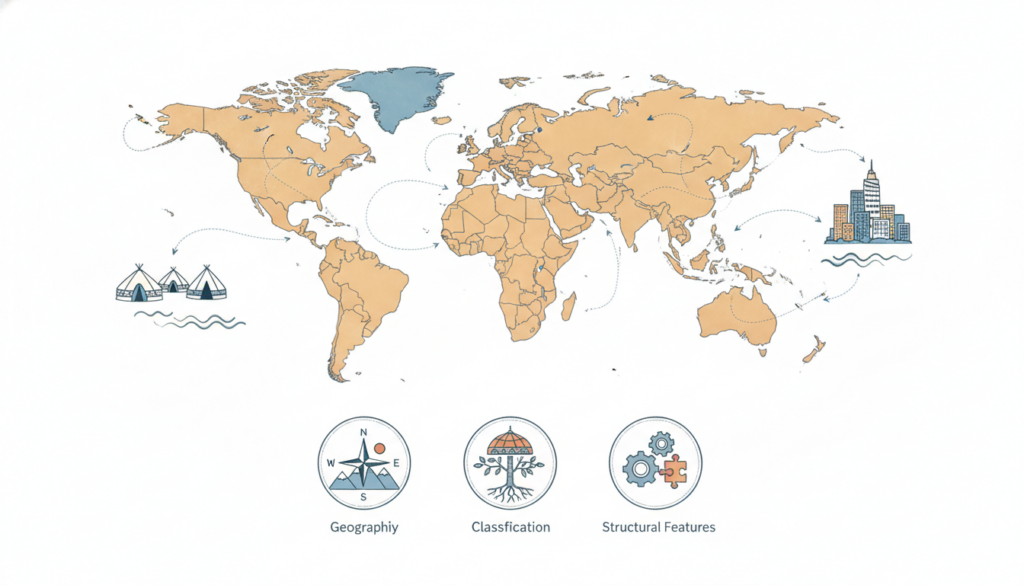
A turkic-speaking community consists of speech populations across Eurasia—ranging from Southeastern Europe and Anatolia through Central Asia to Siberia—that speak languages belonging to the Turkic language family. Encompassing approximately 30 major living languages and over 170 million native speakers, these speech communities share foundational structural traits, including agglutinative word formation, systemic vowel harmony, and subject-object-verb word order.
Understanding how these language groups relate to one another requires examining their geographic spread, genealogical classification, and shared structural mechanics. While geographical distance and historical contact with non-Turkic populations have introduced distinct differences, the underlying core vocabulary and grammatical architecture remain remarkably consistent across regions.
Geographical Branches of Turkic-Speaking Peoples
The Turkic language family is conventionally divided into five primary geographical and genealogical branches. Each branch represents a cluster of speech communities that underwent common sound shifts and morphological developments after diverging from common ancestral dialects.
The Turkic languages form a language family of at least thirty-five documented languages, spoken by Turkic peoples across Eurasia from Eastern Europe and Anatolia to Central Asia and Siberia.
1. Southwestern (Oghuz) Branch
The Oghuz branch accounts for the majority of the global Turkic population. It includes Turkish, Azerbaijani, Turkmen, Gagauz, and Qashqai. These languages are concentrated across Turkey, Azerbaijan, Turkmenistan, northern Iran, and parts of the Balkans. Oghuz languages are characterized phonologically by the softening of initial voiceless stops (such as ancestral *k- turning into *g- in specific phonetic environments) and widespread loss of archaic final consonants.
2. Northwestern (Kipchak) Branch
Spanning the vast Eurasian steppe from Eastern Europe to Western China, the Kipchak branch includes Kazakh, Kyrgyz, Tatar, Bashkir, Karachay-Balkar, Kumyk, and Crimean Tatar. Key phonological features include the preservation of initial voiceless stops and specific consonant mutations, such as shifting historical *j-* to *zh-* or *dj-* in Northern dialects. Readers interested in regional variations can review our detailed analysis on comparing major Turkic branches and communities.
3. Southeastern (Karluk) Branch
Occupying Central Asia’s historic oasis urban centers, the Karluk branch includes Uzbek and Uyghur. These languages historically absorbed significant literary influence from Chagatai, the classic literary medium of Central Asia. Karluk tongues retain archaic lexical roots while demonstrating unique phonetic shifts, such as the partial loss of strict vowel harmony in urban Uzbek dialects under Iranian language contact.
4. Northeastern (Siberian) Branch
The Siberian branch comprises Sakha (Yakut), Tuvan, Khakas, Altay, and Shor, located across Eastern and Central Siberia. Because these populations migrated early or remained geographically isolated from western trade routes, Siberian Turkic languages preserve archaic grammatical features while incorporating distinct vocabulary from neighboring Mongolic, Tungusic, and Paleosiberian language groups.
5. Oghur (Bolgar) Branch
Represented today solely by Chuvash, spoken in the Volga region of Russia, the Oghur branch diverged earliest from Common Turkic. Chuvash displays radical phonetic changes—such as substituting *r* for Common Turkic *z*, and *l* for Common Turkic *š*—rendering it mutually unintelligible with all other modern Turkic tongues.
| Branch | Primary Languages | Primary Regions | Key Phonological Marker |
|---|---|---|---|
| Southwestern (Oghuz) | Turkish, Azerbaijani, Turkmen | Anatolia, Caucasus, Central Asia | Softening of initial stops (*k-* to *g-*) |
| Northwestern (Kipchak) | Kazakh, Kyrgyz, Tatar, Bashkir | Pontic Steppe, Volga, Central Asia | Preservation of voiceless stops; *j-* to *zh-* |
| Southeastern (Karluk) | Uzbek, Uyghur | Uzbekistan, Xinjiang (China) | Retains post-velar consonants (*q*, *gh*) |
| Northeastern (Siberian) | Sakha (Yakut), Tuvan, Altay | Siberia, Russian Far East | Divergent sound shifts; preservation of archaic forms |
| Oghur (Bolgar) | Chuvash | Chuvash Republic (Russia) | Rhotacism (*r* for *z*) and Lambdacism (*l* for *š*) |
Core Linguistic Traits Shared by Turkic Speech Communities
Despite centuries of geographical dispersion, populations maintain a shared linguistic structure. This structural unity allows linguists to identify consistent comparative rules across members of the family.
Glottolog categorizes the Turkic family into distinct sub-branches including South-Western (Oghuz), North-Western (Kipchak), South-Eastern (Karluk), North-Eastern (Siberian), and Oghur, based on rigorous genealogical classification and comparative linguistic data.
Agglutinative Word Structure
Turkic morphology relies on agglutination. Instead of altering root words or using extensive prepositions, grammatical relationships are built by attaching explicit suffixes to an unchangeable root noun or verb. Each suffix performs a single, predictable grammatical function—denoting plural status, possession, case, mood, or tense.
For example, take the root word for house: ev in Turkish or üy in Kazakh. Adding plural, possessive, and ablative suffixes creates a long, transparent word structure:
- Turkish: ev-ler-im-iz-den (“from our houses”)
- Kazakh: üy-ler-i-miz-den (“from our houses”)
- Uzbek: uy-lar-i-miz-dan (“from our houses”)
Systemic Vowel Harmony
Vowel harmony is the phonological rule governing how suffixes attach to roots. Vowels within a single word must agree in specific phonetic features, primarily backness (front vs. back vowels) and roundness (rounded vs. unrounded vowels). If a root contains a back vowel (like a, ı, o, u), all subsequent suffixes automatically adjust to use back vowels. If the root uses front vowels (like e, i, ö, ü), suffixes shift to match.
Word Order and Postpositions
Turkic syntax follows a strict Subject-Object-Verb (SOV) sentence structure. The principal verb always occupies the final position in a neutral clause. Modifiers, adjectives, and relative clauses strictly precede the head noun they modify. Furthermore, Turkic languages use postpositions rather than prepositions. Rather than saying “in the house,” a speaker uses a noun followed by a locative case suffix or a postposition phrase.
Absence of Grammatical Gender
A striking characteristic of all Turkic languages is the total absence of grammatical gender. Nouns are not categorized into masculine, feminine, or neuter forms, nor do third-person pronouns distinguish between male and female subjects. The single third-person pronoun (Turkish o, Kazakh ol, Uzbek u) translates equally to “he,” “she,” or “it.”
Mutual Intelligibility Across Turkic-Speaking Regions
A frequent subject of study among comparative linguists is the degree of mutual intelligibility among turkic-speaking groups. Intelligibility varies dramatically depending on whether two languages belong to the same sub-branch or different branches.
Speakers within the same branch often experience high levels of passive comprehension. A native Turkish speaker can understand Azerbaijani with minimal exposure, as both belong to the Oghuz branch and share sentence cadence, phonology, and core vocabulary. Similarly, Kazakh and Kyrgyz speakers can communicate fluently across their border due to close Kipchak alignment.
Conversely, cross-branch comprehension requires explicit study. While a Turkish speaker and a Kazakh speaker share identical fundamental grammar rules, differences in consonant shifts and loanword history (Turkish drawing historically from Arabic and French, Kazakh from Russian and Mongolic) create barriers during rapid speech. To explore these relationships further, consult our comprehensive guide to the Turkic language family.
| English Concept | Turkish (Oghuz) | Azerbaijani (Oghuz) | Kazakh (Kipchak) | Uzbek (Karluk) |
|---|---|---|---|---|
| Eye | göz | göz | köz | ko’z |
| Water | su | su | su | suv |
| Hand | el | əl | qol | qo’l |
| Day | gün | gün | kún | kun |
| Head | baş | baş | bas | bosh |
Methodological Steps for Studying Turkic Linguistic Relationships
Linguists and polyglots analyzing connection patterns between different speech communities employ a structured four-stage research methodology. This approach systematically separates shared ancestral roots from recent cultural borrowings.
- Morpheme Isolation: Separate inflectional suffixes from the core root stem to locate the base word.
- Phonetic Mapping: Chart regular sound shifts across branches, such as Oghuz initial *g-* corresponding to Kipchak initial *k-*.
- Grammatical Comparison: Analyze how case markers and verb conjugation systems function in each target language.
- Intelligibility Assessment: Evaluate how well speakers process written and spoken forms from sister languages.
Methodological Framework for Comparative Turkic Analysis
Modern Sociolinguistic Trends and Script Transitions
The contemporary landscape of turkic-speaking nations is defined by dynamic script reforms and digital adaptation. Writing systems across Central Asia and the Caucasus have undergone multiple shifts over the last century, reflecting political and geopolitical transitions.
Historically written in Perso-Arabic scripts during the medieval and early modern eras, many Turkic languages transitioned to Latin alphabets in the 1920s, followed by mandatory Cyrillization in the Soviet Union during the late 1930s. Today, several independent republics are executing deliberate script modernizations:
- Latin Alphabet Standardization: Turkey adopted the Latin alphabet in 1928, followed by Azerbaijan in the 1990s, Turkmenistan, and Uzbekistan. Kazakhstan is currently transitioning to a standardized Latin script.
- Cyrillic Script Retention: Kyrgyz, Tatar, Bashkir, and Siberian Turkic languages predominantly continue to use adapted Cyrillic scripts for legal and educational publication.
- Perso-Arabic Usage: Uyghur in Xinjiang and Azerbaijani in northwestern Iran continue to utilize modern adapted forms of the Perso-Arabic script.
To analyze vocabulary differences across different alphabets and dialects, researchers frequently rely on tools such as our multilingual Turkic dictionary resource to map lexical equivalents rapidly across writing systems. In the modern era, digital corpora and computational tools make tracking cross-linguistic variations far more accessible.
Addressing Common Misconceptions About Turkic Languages
Because Turkic studies involve complex historical geography, several common misconceptions persist among students and general researchers.
Misconception 1: “All Turkic languages are dialects of a single language.”
While structural similarities are strong, treating these languages as minor regional dialects overlooks significant phonological, lexical, and syntactical differences. A speaker of Turkish cannot immediately understand complex spoken Sakha (Yakut) or Chuvash without dedicated linguistic training.
Misconception 2: “Turkic belongs to a proven ‘Altaic’ language family.”
In mid-20th-century linguistics, the “Altaic hypothesis” proposed that Turkic, Mongolic, Tungusic, Japonic, and Korean shared a common genealogical ancestor. Modern historical linguistics has largely rejected this hypothesis. Linguists now agree that the shared vocabulary and structural parallels between Turkic and Mongolic are the result of intense historical language contact and mutual borrowing (areal convergence), rather than descent from a single protolanguage.
Misconception 3: “Turkic languages are confined exclusively to Central Asia.”
While Central Asia forms a core geographic anchor, the speech community extends far beyond it. Modern populations live natively in Southeastern Europe, Anatolia, the Caucasus, Iran, Siberia, and Western China, forming a continuous geographic chain across the Eurasian continent.
Frequently Asked Questions About Turkic Languages
How many people worldwide speak a Turkic language?
There are over 170 million native speakers of Turkic languages globally, with total speakers exceeding 200 million when accounting for second-language users.
Which Turkic language has the highest number of speakers?
Turkish is the most widely spoken Turkic language, accounting for roughly 80 million native speakers primarily in Turkey, Cyprus, and Southeastern Europe.
Are Turkic languages related to Arabic or Persian?
No, Turkic languages belong to a completely separate language family from Arabic (Afroasiatic) and Persian (Indo-European), despite borrowing vocabulary from both due to historical contact.
Is Kazakh mutually intelligible with Turkish?
Kazakh and Turkish share fundamental grammar rules and core roots, but mutual intelligibility in spoken conversation is limited due to distinct sound shifts and vocabulary differences between the Kipchak and Oghuz branches.
Why do different Turkic countries use different alphabets?
Alphabet choices reflect twentieth-century geopolitical history, with Latin, Cyrillic, and Arabic scripts adopted based on regional political developments and cultural associations.
Explore Turkic Languages and Comparative Linguistics
Whether you are researching historical sound shifts, studying vocabulary across sister languages, or beginning a new language journey, having access to structured comparative tools is essential for making steady progress. You can explore the individual Turkic languages on our platform or utilize our specialized tools to analyze vocabulary across all nine major branches. Learn more about comparative Turkic linguistics methodology and enhance your understanding today.